Tuesday, 1 August 2017

How to Create a Client Dashboard in WordPress

Do you want to create a client dashboard in WordPress? A custom dashboard in WordPress can help your clients with resources and shortcuts they need to get started. In this article, we will show you how to create a client dashboard in WordPress without writing any code or affecting client’s ability to update their websites.

Creating a client dashboard in WordPress

Why Create a Client Dashboard in WordPress?

As WordPress solutions provider, you’ll come across clients who haven’t used WordPress before, and they are not familiar with HTML, CSS, or WordPress terminology.

By creating a custom dashboard for clients, you can provide them with a lean WordPress interface and improved usability.

It will improve client satisfaction which leads to more repeat work. Your clients will need less support which will also save you time.

That being said, let’s take a look at how to easily create a client dashboard in WordPress.

We will walk you through different steps in the process. You can decide how much you want to customize depending on your client’s requirements.

1. Hide Unnecessary Admin Menus

While building a website for your clients, you may use different WordPress plugins, custom post types, WordPress page builders, and other tools. Many of these tools will add their own menu items in the WordPress admin bar, create custom widgets in the admin dashboard, and add links in the toolbar.

The end result looks a bit messy. For a client who has never used WordPress these additional items make the dashboard look more complicated than it needs to.

WordPress dashboard

Let’s start creating a client dashboard by cleaning up the clutter.

To do that you will need to install and activate the Adminimize plugin. For more details, see our step by step guide on how to install a WordPress plugin.

Upon activation, you need to visit Settings » Adminimize page to configure the plugin.

Adminimize settings

You will see different admin sections listed on the settings page. Clicking on a section will expand it, and you will see the options for that particular section.

Settings for a section in Adminimize

You can show or hide any item listed under a section for different user roles. Carefully review each item before hiding it as this may affect your client’s ability to use their website.

For detailed instructions, see our guide on how to hide unnecessary menu items in WordPress with Adminimize.

2. White Label WordPress Dashboard

The Adminimize plugin covers a lot of options to control the appearance of your WordPress admin dashboard. However, it does not have options to hide the WordPress branding and white labeling the admin area.

White labeling includes replacing the WordPress logo with a custom logo, changing the admin area footer, show or hide items from menus, and more.

First, you need to install and activate the White Label CMS plugin. Upon activation, head over to Settings » White Label CMS page to configure plugin settings.

White Label CMS settings

The settings page is divided into different sections. You can click on a section to expand and view its settings.

Some options in the plugin are also available in Adminimize. If you have already hidden those options, then you can skip them.

For detailed instructions about each section, take a look at our article on how to white label your WordPress admin dashboard.

3. Change The WordPress Dashboard Appearance

WordPress comes with a handful of admin color schemes that users can change from their profiles. You can set a color scheme as default for new users. You can also create a custom color scheme of your own.

Admin color schemer

Want to take it to the next level? Try WordPress admin themes. These themes are available as plugins that you can install to change the appearance of your WordPress admin area.

WordPress admin theme

Here are some free WordPress admin themes and plugins that you can try.

4. Add Helpful Resources to Client Dashboard

When delivering projects to your clients, you will notice that many of them have similar questions. Adding a help or resource section in WordPress client dashboard can help you answer those questions and save time spent on providing support.

The best way to add a help section is by installing and activating the WP Help plugin. Upon activation, the plugin adds a new ‘Publishing Help’ menu item in your WordPress admin bar. Clicking on it will take you to the settings page.

Publishing help

This area will be empty since you haven’t created any help resources yet. Go ahead and click on the ‘Add New’ button to create one.

On the next page, you can create your help document just like you would create a WordPress post or page.

New help document

WP Help uses custom post type for documents, and they are hierarchical like pages. You can create parent and child documents to organize them.

Managing docs

You can also sync documents from another WordPress site. This allows you to use the same documentation for all your client projects.

For detailed instructions, see our guide on how to add a help / resource section in WordPress admin.

5. Creating Custom Dashboard Widgets

Dashboard widgets is the first things user see when they log into the WordPress admin area. This is the best place to point your clients into right direction by adding your own custom dashboard widgets.

Here is a simple dashboard widget code that you can use as a starting point.

You will need to add this code into your theme’s functions.php file or in a site-specific plugin.

add_action('wp_dashboard_setup', 'my_custom_dashboard_widgets');
 
function my_custom_dashboard_widgets() {
global $wp_meta_boxes;

wp_add_dashboard_widget('custom_help_widget', 'Theme Support', 'custom_dashboard_help');
}

function custom_dashboard_help() {

// Content you want to show inside the widget

echo '<p>Welcome to Custom Blog Theme! Need help? Contact the developer <a href="mailto:yourusername@gmail.com">here</a>. For WordPress Tutorials visit: <a href="http://www.wpbeginner.com" target="_blank">WPBeginner</a></p>';
}

Don’t forget to change the content part with your own message. You can use plain HTML for formatting and styling.

Here is how it looked on our demo website.

Custom dashboard widget

For more information, take a look at our article on how to add custom dashboard widgets in WordPress.

That’s all for now.

We hope this article helped you learn how to create a client dashboard in WordPress. You may also want to see our guide on how to boost WordPress speed and performance.

If you liked this article, then please subscribe to our YouTube Channel for WordPress video tutorials. You can also find us on Twitter and Facebook.

The post How to Create a Client Dashboard in WordPress appeared first on WPBeginner.


source http://www.wpbeginner.com/wp-tutorials/how-to-create-a-client-dashboard-in-wordpress/

8 tips for improving your content creation

The rise of content marketing has brought content creation to the forefront for all businesses. This makes it more important than ever to explore the best ways to create effective content.

The definition of effective content for every business may be different, but in general, it still has to bring you closer to your goals.

That’s why effective content has to resonate with your target readers.

Earlier this summer, I gave a presentation entitled “15 ways to improve your content writing” at the Summit on Content Marketing. Here are the first eight of those tips.

Set a writing process

A structured writing process can help you save time and become more productive. As there’s an increasing need for content nowadays, it’s important to find the best process that can help you focus on content creation.

For example, it might be helpful to dedicate a set block of time on your calendar for content writing, putting aside all distractions.

If you start to get stuck, it may be a good idea to stay away from the copy for a while and either take a break or have someone else read it for a fresh perspective.

Creative brainstorming

It’s not always easy to come up with a new content idea, and this can sometimes require some creative brainstorming moments with other team members.

Keeping a content calendar or notebook can help you organize all your ideas, ranked from best to worst – any of these can offer a new perspective on your content goals.

If you’re still struggling for content ideas, take a look at our 21 quick ways to find inspiration for creating content to help you with your next great post.

Grab the reader’s attention

Although the widely-reported ‘fact’ that we now have an attention span of 8 seconds has been called into question, internet users are more discerning with their time than ever before. There is a huge abundance of content available online, and your content needs to be able to grab the user’s attention, and hold it, in order to succeed.

In the digital world, there is any number of competing demands on the user’s attention. Our attention shifts from one task to another as we open new tabs or check multiple screens. Why should the user keep reading – or watching, or listening to – your content? You need to hook their attention and keep it there. 

Explore different types of content

One way to convince users to pay more attention to your content marketing is to mix up your formats. The last few years have seen an explosion in the types of content available to create and host online, with each one serving a different purpose.

Images 

Images are the most popular type of visual content. They offer a powerful impact on a message and they certainly create a memorable experience. It is easier for the human brain to actually process an image and this increases the chances for your copy to be remembered.

As 65% of people are visual learners, there is more chance your readers will notice your content if you pair it with the relevant images.

Infographics

Information graphics, or infographics, are graphic visual representations of information, data or knowledge intended to present information quickly and clearly.  The use of graphics enhances our ability to see patterns and trends, which makes complex information more appealing and shareable.

Readers tend to spend more time processing an infographic, compared with a written text, and that’s what makes them engaging, especially when they are added as part of a blog post. They’re also more shareable than other types of content. In fact, infographics are shared and liked three times more than any other visual content.

This makes them a very useful addition to the promotion of your content, and it’s no surprise that marketers are using them more and more in their content marketing strategy.

Video

Video content has taken the lead as the most popular visual type of content over the last two years, a trend which has been boosted by social media. According to Cisco, videos will make up 80% of all internet traffic by 2019. This highlights how video content is going to become even more important. Even if we don’t use it as our primary form of content, it is still a powerful medium to support our message. 

For example, we can use a short video to:

– share tips and “how-to” ideas

– build trust

– increase engagement

– add value

Live video is another emerging trend, and it offers an immediacy that online users seem to enjoy quite a lot. Marketers and business owners have placed video among their top priorities for 2017 in an attempt to create more appealing and effective content.

Remember, it’s not always necessary to hire a video producer to create short and entertaining videos that offer value to your audience.

GIFs

A GIF, which stands for Graphics Interchange Format, is a type of an animated image that was developed more than 30 years ago. It may not be new, but it’s a popular form of media with online users, as a quick way to share visual content that straddles the line between an image and a video.

According to Giphy, there are currently around 150 million original GIFs out there online. They can be more powerful than an image, but they are also smaller in size than a video. Although GIFs are usually funny and informal, they can still fit with your content strategy, provided that you know how to use them in the right context of course.

For example, how about using a GIF to explain a process in a “how-to” post? Or how about using a funny movie quote in an attempt to show your casual side while trying to show a more personal approach?

GIFs can help you to:

– show your brand’s personality

– divide large chunks of text

– explain a process

– tell a story

What all of these types have in common is the creative way to present content, reaching people who like consuming content in different ways.

For example, if you want to explain a complicated concept, you can use an infographic to make the process easier for your audience. You can still create a blog post, and integrate the infographic with the rest of the written content.

This increases the chances for your audience to stay engaged and enjoy what you have to offer.

Decide on the ideal length for your content

Content marketers often wonder whether long-form content is dead in the era of ‘bite-sized’ content. It may seem logical to assume that readers prefer shorter content, but this isn’t always the case.

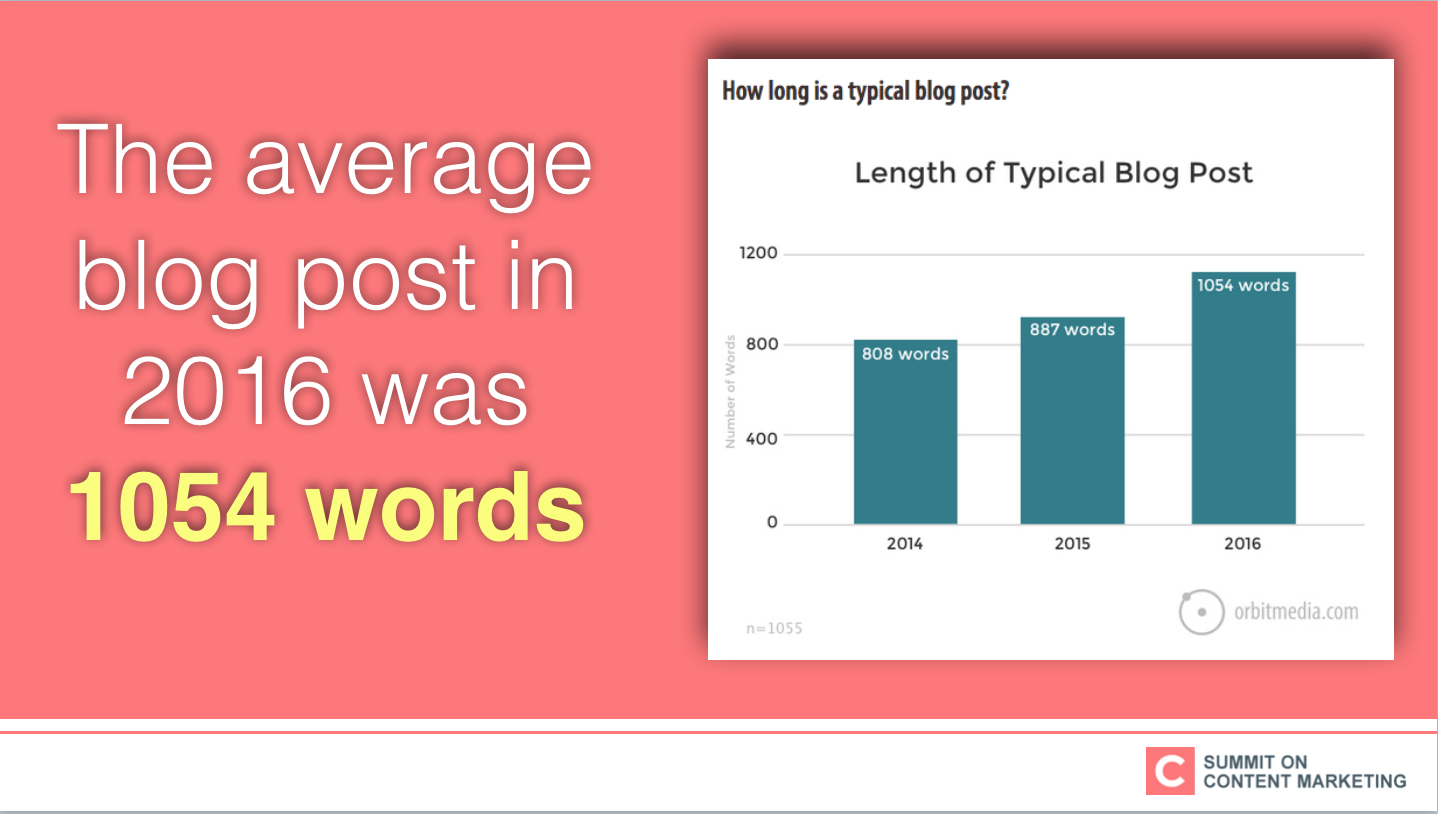
According to Orbit Media Studios, blog content is actually getting longer year by year. In 2016 the average blog post length was 1054 words – up from 887 words in 2015.

This means that readers still value long-form content – provided that it’s interesting of course.

Of course, length alone won’t guarantee the success of your content.

However, the length of your content can indicate the depth of the topic you’re covering. If the goal of your copy is to increase awareness, build trust and offer value, then the length may be a key part of your success.

You just need to find a balance between quantity and quality.

Aim for clear structure

Your readers will appreciate a piece of content that is clear and organized. There’s no need to suffocate your writing with big chunks of sentences.

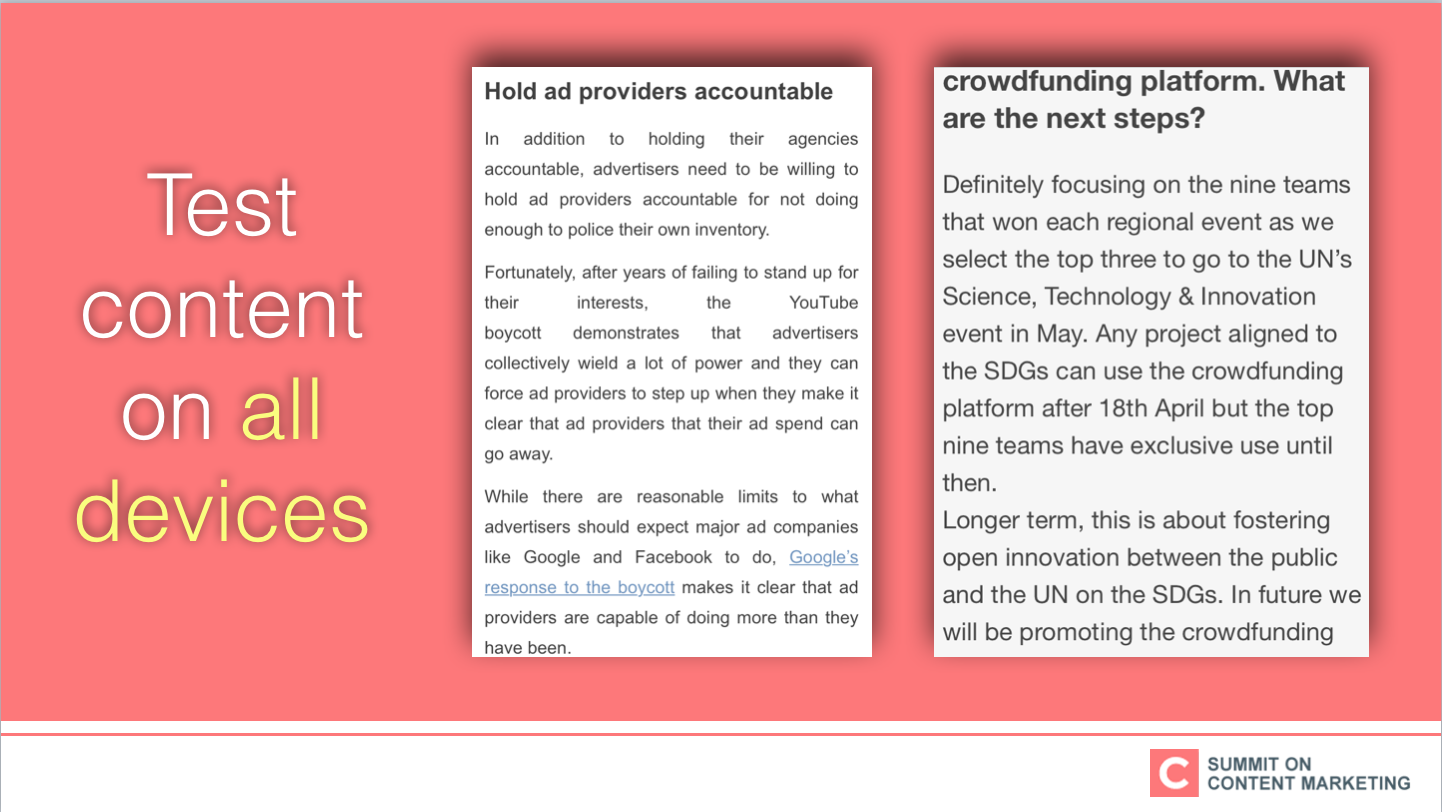
Another point to consider is how people consume content through different devices. Not everyone accesses your content through the same screen, which means that your content has to be optimized for all devices.

This includes its layout. What seems like a small paragraph on a desktop may turn out to be a really big paragraph on a mobile device. And that’s a good reason to test your content on all devices before you publish it.

Moreover, you can organize your thoughts using bullet points, which has the dual benefit of being direct and practical, while also being more clearly readable, helping readers to focus on the most important aspects of your message.

Bullet points can be useful at the end of a piece of text as an overview of what you’ve covered. This is a quick way to allow readers to get back to the things they need to remember from what they’ve just read.

Beware, though – too many bullet points can produce the exact opposite result.

Spend time on formatting your content

How does formatting differ from structure? This has to do more with the way you present your actual content, rather than the way you organize the sentences. However, they are both important in their own way, with the ultimate goal being to convince readers to spend more time on your content.

For example, if you want to make your content more appealing, then you need to add images throughout the text. It’s usually suggested we add the images in a way that they separate the longer paragraphs. If you want to make a point through a series of paragraphs, then break those up with an image that supplements your content, giving the readers’ eyes a break.

When it comes to formatting, one of the most important tips is to pay attention to headings.

Headings allow you to divide your content into logical sections, each one headed up by a catchy title. Spend a decent amount of time thinking up each heading – and don’t be afraid to use plenty of them.

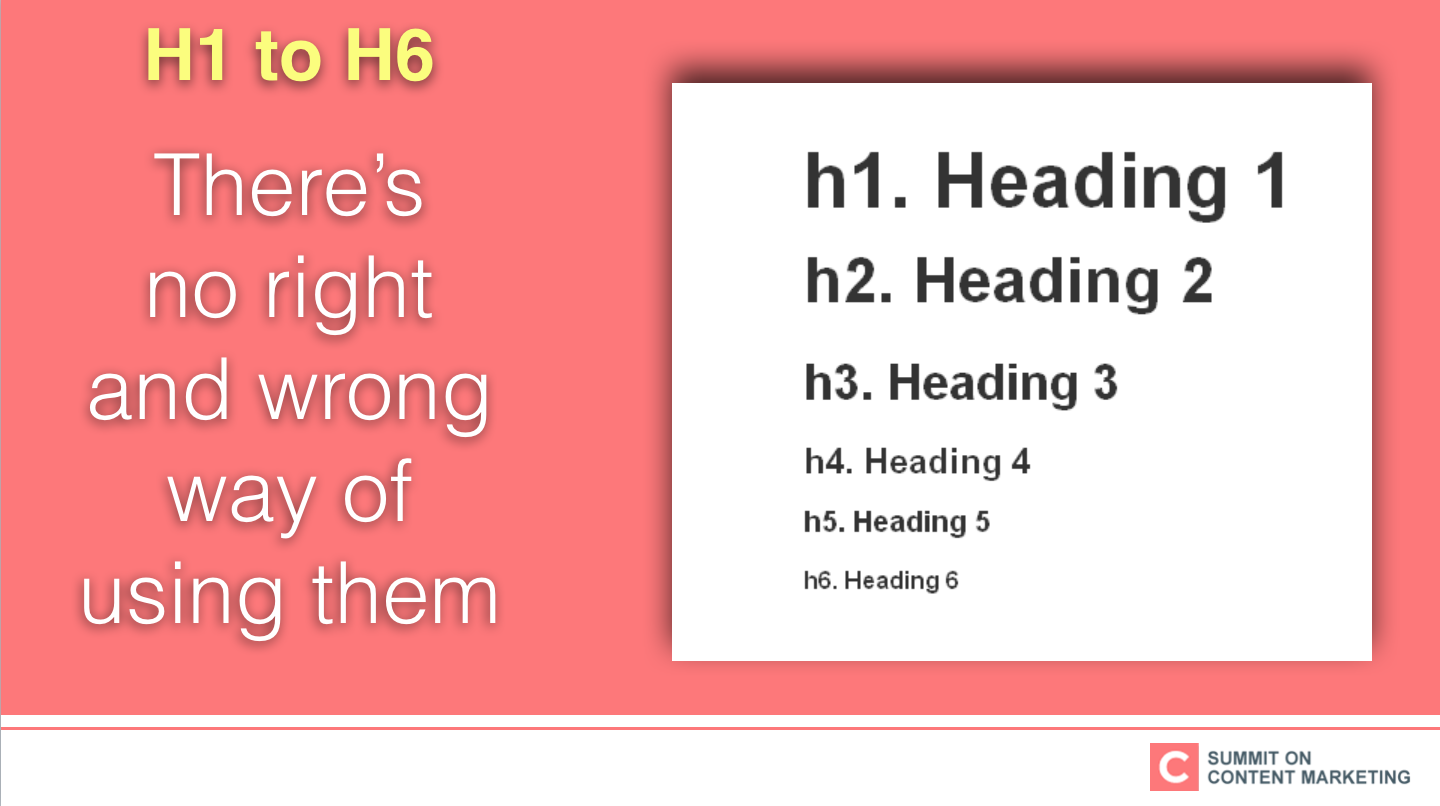
Ranging in terms of importance (and font size), headings span from H1 to H6. You can use a range of different header sizes if you want to label certain sections of your content with subheadings, or you can stick with just a couple throughout.

It’s also useful to keep in mind that headings contribute to SEO and the way search engines discover your content. As crawlers, the magic bots that search for content, access your writing, headings make your content structure easier to parse, and help to highlight the important bits.

Thus, if your headings are relevant and interesting, you’re also going to help your content rank well in search.

Set a goal for your content

Before you dive into content writing, it’s useful to set a goal of what you want to achieve with your content.

There are many ways to use your content. Not every post should serve the same goal and in fact, it’s useful to have a variety of content with different purposes.

For example, your latest post can promote your new product, but it’s probably not a good idea to do that with a series of ten posts in a row.

Readers don’t like overt promotion via content, but you can still create valuable content that happens to also be promotional. Just ensure that your content serves a genuine purpose beyond promoting whatever you want to draw attention to. Ask yourself: What would I, as the reader, be able to learn from this?

While setting a goal for your content, make sure you’re not turning your content into an automatic machine of business jargon. It’s easy to fall into the trap of thinking of the outcome more than the actual process before it. If you’re only thinking of the goal and not the copy, then you risk losing your unique brand voice and your readers along with it.

Set a goal, then start writing, leave the goal aside and focus on your content. Once your post is published and you’re tracking metrics, you can return to the initial goal and see whether you’ve come close to achieving it.

Tune in tomorrow for Part 2 of this post, where we’ll look at seven more tips that can improve your content marketing.


source https://searchenginewatch.com/2017/08/01/8-tips-for-improving-your-content-creation/

SecuPress has left WP Media


Some History Back in 2014, Jonathan, Jean-Baptiste and me co-founded WP Media. We almost had the same creation way in mind. WP Rocket was our first product, and then we created 2 more products.
This error, the creation of Imagify and SecuPress at the same time, cost us a lot and we think it’s a fail today.
The Errors
It is hard to create 2 products at the same time, remember that WP Rocket still had to grow to pay everyone and more for the 2 other products now. Then WP Media grown in people, we had to manage that too.
The other error is that we did not budgetize the product creation, so SecuPress gave the impression to eat eat eat on WP Rocket. The product still needed some resources that WP Media could not afford. The ROI date streched out.
Time Flies
With time, we 3 co-founders had more accurate opinions and most of the time opposite ones. This lead us to a deadend even with our open mind, all is not easy with open minds too.
Jonathan and Jean-Baptiste announced me that they wanted to stop the collaboration between WP Media and me, but they handed SecuPress over because they know that SecuPress is “my” product..
It’s true that since 2012 this idea was in my
Source: https://managewp.org/articles/15757/secupress-has-left-wp-media


source https://williechiu40.wordpress.com/2017/08/01/secupress-has-left-wp-media/

Democratize Multilingual WordPress – TranslatePress Beta


WordPress by default is NOT multilingual. You can setup your language when installing it, but that just localizes your site to a language so your WordPress in more languages is not something as straight forward as publishing a post. Because of this, adding the multilingual functionality can be done through a translation plugin, setting up a WordPress Multisite or using machine translation.
In this post we’ll go through finding what’s currently possible, what problems you can encounter, talking about machine translations and showing you how you can simplify everything by just taking a different approach that combines the best of both worlds: machine translation and manual translations combined.
We’ll go through:
Introduction
A WordPress plugin for translations
Human Translations
Automatic and Semi-Automatic Translations
WordPress Multisite where a subsite represents a language
Using a 3’rd party for your translations
Conclusions
TranslatePress Beta
The Future of TranslatePress
Introduction
Unless you’re a real language geek like these guys, setting up WordPress in more languages can be anything between a slight annoyance to a real problem that can stop your
Source: https://managewp.org/articles/15756/democratize-multilingual-wordpress-translatepress-beta


source https://williechiu40.wordpress.com/2017/08/01/democratize-multilingual-wordpress-translatepress-beta/

Hackers Find Fresh WordPress Sites Within 30 Minutes

Source: https://managewp.org/articles/15755/hackers-find-fresh-wordpress-sites-within-30-minutes


source https://williechiu40.wordpress.com/2017/08/01/hackers-find-fresh-wordpress-sites-within-30-minutes/

This 1 Star Review of WordPress Gutenberg Editor is Gold “A Visit from St. Gutenberg”


While the Gutenberg editor is getting developed to be merged in the group, the beta version is available on the WordPress.org repository for users to test. At the time of writing, there are 1000+ active installs for Gutenberg plugin which has 21 ★★★★★ stars , 3 ★★★★ stars, 2 ★★★ stars, 3 ★★ stars and 46 ★ star ratings.
In those 46 one ★ star ratings, one rating from Web242 Media — which is a Vancouver based Web Design and Web Development company, is totally worth a read!
Here’s how it goes:
A Visit from St. Gutenberg
‘Twas the night before 5.0, when all through the house
Not a blogger was stirring, not even a mouse;
The WordPress core was updated with care,
In hopes that St. Gutenberg soon would be there;
Matt and his team were nestled all snug in their beds;
While visions of WordPress danced in their heads;
And Matt in his ‘kerchief, and team in their cap,
Had just settled their brains for a long Summers’s nap,
When out of Automatic there arose such a clatter,
Matt rose from his bed to see what was the matter.
Away to his computer he flew like a flash,
Logged into WordPress and threw up the Dash.
The moon on the edge of the new-fallen code,
Gave a lustre
Source: https://managewp.org/articles/15754/this-1-star-review-of-wordpress-gutenberg-editor-is-gold-a-visit-from-st-gutenberg


source https://williechiu40.wordpress.com/2017/08/01/this-1-star-review-of-wordpress-gutenberg-editor-is-gold-a-visit-from-st-gutenberg/

Monday, 31 July 2017

Gutenberg 0.6.0 Changes Text/Paragraph Block Behavior, Adds New Cover Text and Read More Blocks


Gutenberg 0.6.0 was released over the weekend with significant changes to the way paragraphs are created within text blocks. In previous versions of the plugin, pressing enter would create a line break inside a paragraph. This release modifies the behavior of the text/paragraph block to split the block when a user presses enter. (Line breaks can still be created by pressing SHIFT+ENTER.) This update is a small improvement in that it hides the text formatting bar when you continue on with a new paragraph, but the slightest scroll or move of the mouse brings it back into view. Contributors are considering adding a buffer at some point that would only trigger the UI after the mouse moves a certain number of pixels.
Unfortunately, the “New Paragraph” placeholder text is intrusive and distracting. It is a constant, unwanted reminder of the structure of your document, which is not helpful if you are trying to stay in the flow of writing.
Gutenberg may improve the experience of vertically stacking differently formatted content, but the writing experience still needs a great deal of work before it can be comparable to what WordPress currently provides. The new editor still gets
Source: https://managewp.org/articles/15753/gutenberg-0-6-0-changes-text-paragraph-block-behavior-adds-new-cover-text-and-read-more-blocks


source https://williechiu40.wordpress.com/2017/08/01/gutenberg-0-6-0-changes-textparagraph-block-behavior-adds-new-cover-text-and-read-more-blocks/