Monday, 29 October 2018

How to Point a Domain from Namecheap to your Wordpress Blog


When you set up your Website with Siteground , you need to ensure that the domain name is set up and your readers are served with the right content when they visit your domain. If you do not do so, they will most likely see the default parking page or a “Server not Found” error. Namecheap Coupon Code : Get 10% discount on domains
To point your domain name to your SiteGround website from Namecheap, you need to login to both your Namecheap and SiteGround accounts.
Log into your Siteground Control Panel
On the SiteGround account page, click on “Manage Account” and find the”Account DNS”. There you will see two nameservers listed together with corresponding IP addresses.
They will look like this
ns1.siteground****.com
ns2.siteground****.com
Copy the two nameservers to clipboard. These are the values you must fill on the Namecheap page.
Access your Namecheap account
Log in to your Namecheap account. From the dashboard, you can manage all the services you have purchased from Namecheap.
Click the Domain Management Page
On the left navigation menu, Find the “Domain List” link. Click on the link, you will be presented with the domain names you have
Source: https://managewp.org/articles/18033/how-to-point-a-domain-from-namecheap-to-your-wordpress-blog


source https://williechiu40.wordpress.com/2018/10/29/how-to-point-a-domain-from-namecheap-to-your-wordpress-blog/

Saturday, 27 October 2018

Top Things Overlooked When Launching a New Website


If you’re launching a new website, properly planning everything before it goes live is essential. This will allow you to get started right and avoid various potential problems once your site goes live. After all, it’s easier to make sure you got things right at the start, rather than correcting them after the site is launched. Compatibility with Mobile Devices
The majority of Internet usage is now done on mobile devices, as opposed to a desktop PC. It is therefore imperative that you ensure your website will display properly when viewed on the smaller screen of a smartphone or tablet.
One of the best ways to accomplish this is by using responsive design. Many website templates and themes for popular content management systems like WordPress and Joomla are now responsive, meaning that they automatically adapt themselves to the user’s screen size. You can use a variety of free online tools to check how your website will display in various browsers on different devices.
An Intriguing Coming Soon Page
When you’ve registered your domain name and are in the process of finalizing your website, it’s always a good idea to create a Coming Soon page that will capture
Source: https://managewp.org/articles/18032/top-things-overlooked-when-launching-a-new-website


source https://williechiu40.wordpress.com/2018/10/27/top-things-overlooked-when-launching-a-new-website/

Friday, 26 October 2018

10 fun facts (and a typo) from the original Google paper by Larry and Sergey

Yesterday while I was having a blast reading “The Anatomy of a Large-Scale Hypertextual Web Search Engine,” I happened across some fun facts.

We got into some of the more technical goods from the paper yesterday, but figured these would also be an worthwhile — or at least more enjoyable — read. Friday and all.

1. “Wow, you looked at a lot of pages from my web site. How did you like it?” – people encountering a crawler for the first time

They note that they received almost daily emails from people either concerned about copyright issues or asking if they liked the site after looking at it. For many people with web pages, this was one of the first crawlers they had seen.

“It turns out that running a crawler which connects to more than half a million servers, and generates tens of millions of log entries generates a fair amount of email and phone calls. Because of the vast number of people coming on line, there are always those who do not know what a crawler is, because this is the first one they have seen. Almost daily, we receive an email something like, “Wow, you looked at a lot of pages from my web site. How did you like it?” There are also some people who do not know about the robots exclusion protocol, and think their page should be protected from indexing by a statement like, “This page is copyrighted and should not be indexed.”

More innocent times.

2. A billion web documents predicted by 2000

“It is foreseeable that by the year 2000, a comprehensive index of the Web will contain over a billion documents. . . The goal of our system is to address many of the problems, both in quality and scalability, introduced by scaling search engine technology to such extraordinary numbers.”

Now in 2018, there are reportedly 130 trillion documents on the web — an extraordinary number indeed. And sure enough, their search has scaled to meet it.

3. Google took up 55 GB of storage

“The total of all the data used by the search engine requires a comparable amount of storage, about 55 GB.”

Now, Google is 2 billion lines of code. As noted by one of their engineering managers in 2016, the repository contains 86TB of data.

4. “People are still only willing to look at the first few tens of results.”

Please note: “tens.”

They write about the need for more precision in search. Remember the days when people regularly clicked past page 1?

5. Percentage of .com domains: from 1.5 to 60, to now 46.5

They note how “commercialized” the web was already becoming, leaving search engine technology “to be largely a black art and to be advertising oriented.”

“The Web has also become increasingly commercial over time. In 1993, 1.5% of web servers were on .com domains. This number grew to over 60% in 1997.”

According to Statistica, the number of .com domains is down to 46.5% as of May 2018.

“With Google,” they wrote, “we have a strong goal to push more development and understanding into the academic realm.”

6. “There are two types of hits: fancy hits and plain hits”

After going into some technical detail about optimized compact encoding, they reveal that they’ve their complex compact encoding preparations are categorized simply — endearingly — into fancy and plain.

7. Already defending user experience in anticipating search

From the start, it seems Brin and Page fought for users to not need to excessively specify their queries in order to get desired information. They wrote:

“Some argue that on the web, users should specify more accurately what they want and add more words to their query. We disagree vehemently with this position. If a user issues a query like “Bill Clinton” they should get reasonable results since there is a enormous amount of high quality information available on this topic. Given examples like these, we believe that the standard information retrieval work needs to be extended to deal effectively with the web.”

It’s interesting that this was so clearly in their thinking from the beginning. At last week’s Search Summit, Googler Juan Felipe Rincon said, “The future of search is no search, because search implies uncertainty. Instead, it will be about how you populate something before someone knows what they don’t know.”

8. There was a typo

In the second paragraph of section 3.2, they write “Couple this flexibility to publish anything with the enormous influence of search engines to route traffic and companies which deliberately manipulating search engines for profit become a serious problem.”

Did you catch it? The verb should be, “companies which are deliberately manipulating search engines become” or “companies which deliberately manipulate search engines become.” Of the utmost gravity, we know.

Just goes to show that even if an incomplete verb phrase won’t keep you from doing some pretty cool stuff in the world. And of course, that even the best of us need editors.

9. Search Engine Watch shout out

We tweeted this yesterday, but felt the need to share again for extra emphasis. Our very own Search Engine Watch was cited in the paper, stating that top search engines claimed to index 100 million web documents as of November 1997. Been a fun 21 years.

10: They chose these photos

Happy Friday, everyone.


source https://searchenginewatch.com/fun-facts-original-google-paper

New Add-on Directory and Community Forums for Gravity Forms!


Remember our post back in March when we asked 3rd-party developers for information on their products? Well, It’s time to unveil the newest addition to the Gravity Forms website that we’ve been working so hard on, and it’s all about the Gravity Forms community! Since Gravity Forms was launched over 9 years ago, it’s gained quite a following within the WordPress community. Every day, developers around the world are releasing new Gravity Forms add-ons that continue to push the boundaries of how user input is obtained, processed, and displayed on WordPress sites. With such a massive following, we’ve decided to focus our efforts over the last several months on those 3rd-party add-ons that make Gravity Forms the powerhouse that it is.
Introducing the Gravity Forms Add-On Directory
Here at Gravity Forms, we pride ourselves in putting our customers first and giving them as many resources as possible to make their forms the best that they can be. Many times, the perfect solution is inside a 3rd-party add-on that they might not otherwise know exists. That’s why we’ve created the Gravity Forms Add-On Directory where new add-ons can be discovered much more easily, regardless of where they are hosted.
Source: https://managewp.org/articles/18031/new-add-on-directory-and-community-forums-for-gravity-forms


source https://williechiu40.wordpress.com/2018/10/26/new-add-on-directory-and-community-forums-for-gravity-forms/

Iterating on Merge Proposals


Developing new WordPress features as plugins has been a wonderfully valuable process for all sorts of features to come into being, from the MP6 Dashboard Redesign, to oEmbed endpoints, and including multiple Customiser enhancements over the years. Thanks to the flexibility that this model offers, folks have been able to iterate rapidly on a wide range of features, touching just about every part of WordPress. The “Features as Plugins” idea was first introduced during the WordPress 3.7 development cycle, during which the features were merged after a short discussion during a core chat: it was only in the WordPress 3.8 cycle that the idea of a merge proposal post (called “Present Your Feature” back then) came into being. It was envisioned as a way to consult with WordPress leaders, key contributors, and the wider WordPress community on the readiness of this feature to be released. Ultimately, WordPress leaders would make a decision on whether the feature was right for WordPress, and the release lead would decide if it was ready for that release.
Since then, most feature plugins have published some form of merge proposal post before they were ultimately merged into
Source: https://managewp.org/articles/18030/iterating-on-merge-proposals


source https://williechiu40.wordpress.com/2018/10/26/iterating-on-merge-proposals/

What You Need To Know About WordPress SEO – WordPress Form Builder


Erik Wardell is a digital marketer specializing in search engine optimization (SEO). At Pathfinder SEO he works directly with subscribers to coach them through the SEO process. He is passionate about taking complex SEO topics and making them more approachable for website owners and freelancers. If you are building a WordPress website and want people to find it, it needs to be discoverable in search engines such as Google, Yahoo, and Bing. Learn how to generate more revenue and increase sales from your website by increasing the traffic with SEO.
What Is SEO?
Search engine optimization is the process of generating free or organic traffic to your website from Google, Yahoo, and Bing. SEO is both an art and a science. While the practice of SEO changes as the search engine algorithms evolve, there are foundational, long-lasting practices that you can implement to get found in Google, Yahoo, and Bing.
Why Is SEO Important?
SEO is one of the most affordable and effective digital marketing strategies out there. Many digital marketing techniques like pay-per-click advertising, newsletters, and social media immediately cease to drive web traffic when discontinued. SEO generates a long-lasting
Source: https://managewp.org/articles/18029/what-you-need-to-know-about-wordpress-seo-wordpress-form-builder


source https://williechiu40.wordpress.com/2018/10/26/what-you-need-to-know-about-wordpress-seo-wordpress-form-builder/

6 Best Accounting Software for Small Businesses (Compared)

A lot of readers on WPBeginner are web professionals, and one of the questions we recently received was: which is the best accounting software for web professionals? Working on your own business requires you to maintain your accounts, track earnings, expenses, taxes, invoices, and more. Luckily, there are some really great software that can help you streamline the process. In this article, we have hand-picked the best accounting software for small businesses and web professionals.

Best Accounting Software for Small Businesses

Why Use an Accounting Software?

When you’re just starting out, you can use a simple spreadsheet to manage your finances. However as your income and expenses grow, things get more complicated.

You will need to keep track of invoices, online payments, other income, expenses, and taxes. If you don’t streamline the process, then you will end up spending more time on these things and still not get them done properly.

An accounting software helps you easily keep track of your finances, manage invoices, do the bookkeeping, and help you calculate taxes. This helps you save a ton of time while enabling you to manage your money more efficiently.

That being said, let’s take a look at some of the best accounting software for web professionals, freelancers, and small businesses.

Best Accounting Software for Professionals

We will be looking at the top accounting software used by thousands of professionals around the world. Our goal is to highlight the ones that are easy to use, affordable, and offer the necessary features.
1. QuickBooks

Quickbooks

QuickBooks is one of the most popular accounting software for web professionals and freelancers. You can easily connect it to your bank accounts, PayPal, and credit cards to automatically capture all your transactions.

It also allows you to send invoices to your customers and track them inside the app. Your customers can also directly pay by clicking on the payment button on their invoice.

QuickBooks make accounting easier for non-accountants. It comes with beautiful reports that give you a quick overview of your finances as well as detailed reports of all your expenses, earnings and invoices.

Another benefit of using QuickBooks is the ability to manage taxes. If you are using software like TurboTax, then QuickBooks can save you a ton of time when filing your taxes.

It comes with easy to use apps for mobile devices which allows you to capture receipts, manage finances, and view reports on the go.

Pricing: Small Business plans start at $10 / month, Self Employed plans start from $5 / month.
2. Godaddy Bookkeeping

GoDaddy BookKeeping

Most of you probably know GoDaddy as one of the biggest domain name registration companies in the world. However, they offer a ton of other services including a cloud-based bookkeeping software for small businesses.

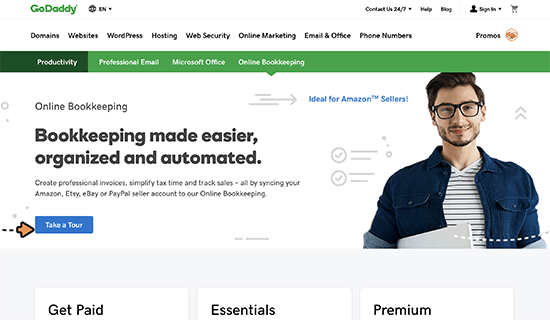
GoDaddy Bookkeeping allows you to sync your bank, credit card, Amazon, Etsy, eBay or PayPal seller accounts to their bookkeeping platform. It then automatically tracks all your transactions and displays them with your total profit and loss report always visible on the top.

It also includes easy invoice management, with recurring invoices, and integrated payments via Stripe or PayPal. It is great for freelancers and small businesses who are looking for simpler bookkeeping solution however it lacks some advanced features that you will find in other apps on the list.

Pricing: Starting from $3.99 per month.
3. Freshbooks

Freshbooks

FreshBooks is an ideal software for freelancers. It is one of the easiest apps to send and track invoices for freelancers and self-employed professionals.

It also allows you to track your expenses, capture receipts, manage projects you are working on, and accept payments from clients. It connects with your bank accounts to deposit payments directly.

There are beautiful reports inside the FreshBooks dashboard which makes accounting dead simple for everyone. It has a mobile app which gives you the freedom to see and manage things on the go.

Pricing: Starting from $15 / month.

4. Xero

Xero

Xero is another powerful web-based accounting software for professionals and small business websites. It offers plans and features that grow as your business needs grow.

Xero helps you easily send invoices, accept payments, view bank transactions, manage contacts, and more. You can create multi-currency accounts, manage payroll if you have employees, and even manage your projects within the app.

It offers a simple and easy to use interface with beautiful reporting tools. It is packed with a lot of features many of which you’ll probably never use as a freelancer, but you may need them as your business grows.

Pricing: Starter plan costs $9 per month, but it is too limited. You will need the standard plan which costs $30 per month.
5. Wave

Wave

Wave offers a free accounting software for small business. It allows you to easily manage all your finances by connecting your bank and credit card accounts to the app. It then tracks all your transactions and presents them in an easy to understand reports.

It also allows you to send manual, automatic, and recurring invoices. With the mobile app, you can capture receipts on the go and keep track of things from anywhere.

The basic software is free to use. However, there are transaction fees for credit card payments 2.9 % + 30 cents per transaction, and for ACH transfers 1% per transaction. If you have employees, then you should know that their payroll software is paid and not included in the free plan.

Pricing: free accounting software, transaction charges, and paid payroll software.

6. Zoho Books

Zoho Books

Zoho is a well-known CRM software. With Zoho Books, they add professional accounting software to their suite of apps. The biggest advantage you’ll get by using Zoho is when you are using their CRM apps.

It connects well with other apps in their ecosystem as well as several payment gateways, bank accounts, and your credit cards. This allows you to completely automate your bookkeeping.

You can also share transactions with your customers by giving them access to their client portal. You can even enable Bulk payment feature to get paid faster by your clients.

Pricing: Starting from $9 per month.

Conclusion

If you’re looking for the most comprehensive solution, then we recommend using QuickBooks.

If you’re a small business owner who just wants a simple solution, then we recommend taking a look at GoDaddy Bookkeeping.

We hope this article helped you find the best accounting software for small businesses, professionals and freelancers. You may also want to see our article on best businesses phone services and best email marketing services for small businesses.

If you liked this article, then please subscribe to our YouTube Channel for WordPress video tutorials. You can also find us on Twitter and Facebook.

The post 6 Best Accounting Software for Small Businesses (Compared) appeared first on WPBeginner.


source https://www.wpbeginner.com/showcase/best-accounting-software-for-small-businesses-compared/